








Backdrops in E-Commerce: Boost Product Appeal Fast
Your product photography can make or break a sale. The difference between a scroll-past and a conversion often comes down to one overlooked element: your backdrop. Professional sellers know that backdrops eliminate distractions and focus attention on what matters most. This guide shows you exactly how to choose, set up, and use backdrops to transform your product images from forgettable to irresistible, whether you’re shooting for Amazon, Instagram, or your own storefront.
Table of Contents
- Why backdrops matter: More than a backdrop
- Backdrop materials and types: Options, costs, and best uses
- Technical execution: How to set, light, and avoid common mistakes
- Matching backdrop to channel: White for compliance, color for story
- Expert strategies: Durability, versatility, and working smarter
- Upgrading your product shots? Instant Backdrops can help
- Frequently asked questions
Key Takeaways
| Point | Details |
|---|---|
| Backdrops drive conversions | A professional backdrop draws focus to your product and follows platform rules to boost sales. |
| Choose the right material | Vinyl, paper, and foam each balance cost, durability, and look for specific e-commerce needs. |
| Match backdrop to channel | Use pure white for main listings and colored or textured backdrops for ads and visual storytelling. |
| Master technical setup | Distance, lighting, and maintenance all play a role in flawless backdrop results. |
| Durability equals value | Investing in quality, versatile materials like vinyl or canvas saves time and money long-term. |
Why backdrops matter: More than a backdrop
Backdrops do far more than fill space behind your products. They’re strategic tools that directly impact your bottom line.
First, they eliminate visual noise. When customers land on your listing, their eyes should go straight to your product, not competing patterns or cluttered backgrounds. A clean backdrop creates instant focus.
Second, platform compliance matters. Amazon requires pure white backgrounds for main product images, and violating this rule can get your listings suppressed. Other marketplaces have similar standards. The right backdrop keeps you compliant and visible.
Third, consistency builds trust. When your entire catalog shares a cohesive visual style, customers perceive your brand as professional and reliable. Inconsistent backgrounds signal amateur hour.
Finally, backdrops enable storytelling. While white backgrounds work for compliance, colored or textured backdrops let you establish mood and context for lifestyle shots. A rustic wood backdrop tells a different story than sleek marble, and that story influences buying decisions.
Pro Tip: Shoot your main listing images on white for compliance, then create secondary lifestyle images with colored backdrops for your product gallery and social media. This hybrid approach maximizes both platform performance and engagement.
Understanding the backdrop role in product success transforms how you approach every shoot. It’s not decoration. It’s strategy.
Backdrop materials and types: Options, costs, and best uses
Choosing the right backdrop material affects your workflow, budget, and image quality. Let’s break down your options.
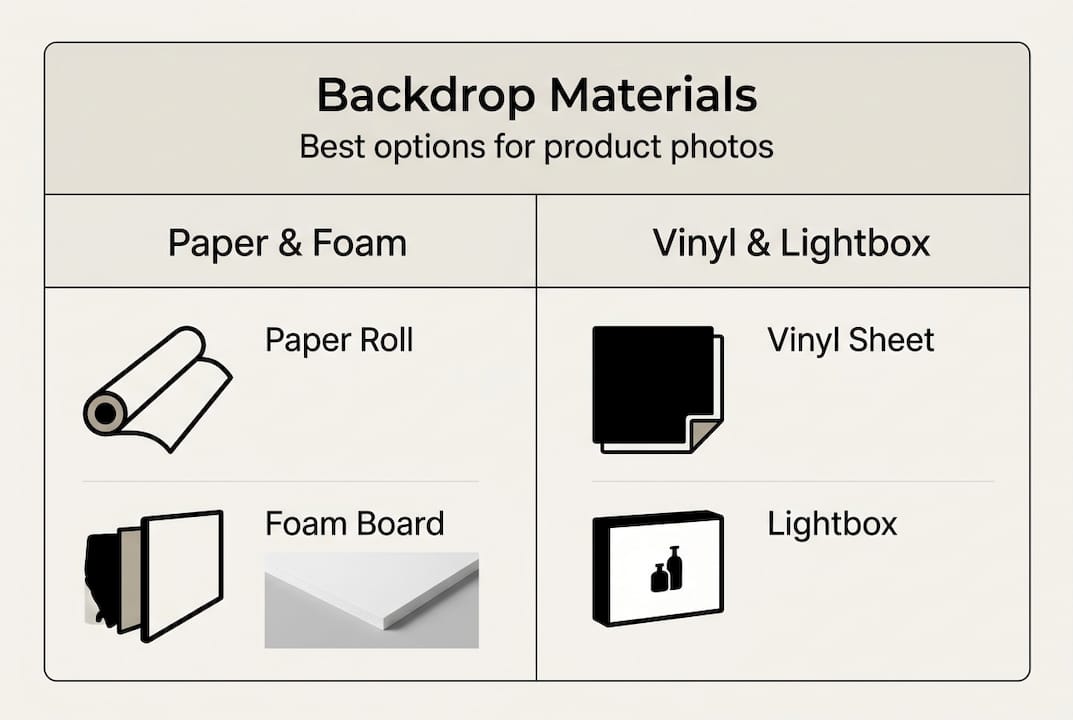
Paper rolls are the traditional choice. White seamless paper rolls cost $30–$50 and last hundreds of shoots if you’re careful. They’re affordable and create smooth, professional curves when positioned correctly. The downside? They tear easily, stain permanently, and require storage space. Best for: high-volume sellers shooting similar products repeatedly.
Vinyl backdrops offer durability and versatility. They’re waterproof, stain-resistant, and reusable across thousands of shoots. Vinyl handles spills, wipes clean, and comes in realistic textures like wood, marble, and concrete. Initial cost runs higher than paper, but the per-shoot cost drops dramatically over time. Best for: food photography, jewelry, and any scenario where liquids or oils might contact the surface.
Foam boards provide rigid, portable solutions. They’re lightweight, inexpensive, and perfect for small products. White foam core boards cost just a few dollars and work great for jewelry, cosmetics, or tech accessories. They don’t create seamless curves like rolls, so you’ll see the horizon line in some shots. Best for: small product photography and tabletop setups.

Lightboxes combine backdrop and lighting in one unit. Lightboxes cost $50–$150 for small product sizes and deliver consistent, diffused lighting with built-in white backgrounds. They’re foolproof for beginners but limit creative control. Best for: sellers prioritizing speed and consistency over artistic flexibility.
Here’s how these options compare:
| Material | Cost Range | Durability | Best For | Reusability |
|---|---|---|---|---|
| Paper rolls | $30–$50 | Low | High-volume, similar products | Moderate |
| Vinyl | $60–$120 | High | Food, jewelry, versatile use | Excellent |
| Foam boards | $5–$15 | Moderate | Small products, portability | Good |
| Lightboxes | $50–$150 | High | Beginners, speed, consistency | Excellent |
When selecting materials, consider your product type and shooting frequency. Reflective items like jewelry need non-reflective backdrops. Food photography demands waterproof surfaces. High-volume sellers benefit from durable materials that withstand daily use.
Pro Tip: Create seamless curves by positioning your backdrop 3–4 feet behind your product and letting it curve naturally to the floor. This eliminates horizon lines and creates that professional studio look.
Exploring different photography background types helps you match materials to your specific needs. The right choice depends on what you’re shooting, how often, and your growth plans. For guidance on backdrop material options, consider durability against your shooting schedule. Choosing realistic backdrop choices elevates perceived product value instantly.
Technical execution: How to set, light, and avoid common mistakes
Perfect backdrop selection means nothing if your technical execution falls short. Here’s how to set up and light your backdrops for professional results.
Distance matters more than you think. Place your product 6–10 feet from the backdrop when possible. This separation prevents color spill, where backdrop color reflects onto your product and creates unwanted tints. It also gives you control over backdrop brightness through independent lighting.
Lighting separation creates depth. Light your product and backdrop separately. Use your main light for the product, then add a background light to control backdrop tone. Want pure white? Overexpose the backdrop by one to two stops. Want gray? Underexpose it. This independence lets you fine-tune the exact look you need.
Edge cases require special attention. White products need rim lights to separate from white backgrounds. Without edge definition, your product disappears. Reflective items like glassware or polished metal need angle adjustments to control what appears in reflections. Shoot from slightly above or use polarizing filters to minimize unwanted reflections.
Here’s your technical setup checklist:
- Position backdrop 6–10 feet behind product for color control
- Set up main product lighting first
- Add separate backdrop lighting for tone control
- Check for color spill on product edges
- Add rim lighting for white or light-colored products
- Adjust camera angle for reflective surfaces
- Use negative fill (black cards) to deepen shadows if needed
- Test shoot and adjust lighting ratios
Shadow control separates amateurs from pros. Harsh shadows distract from products. Use diffusers or bounce cards to soften your main light. Position your product far enough from the backdrop that shadows fall out of frame or become soft and subtle. For pure white backgrounds, eliminate shadows entirely by overlighting the backdrop.
Pro Tip: Color spill ruins white background shots faster than anything else. If you notice color tints on your product edges, increase the distance between product and backdrop, or use black negative fill cards on the backdrop side to block reflected light.
Mastering these techniques through your guide for backdrop shots builds consistency across your catalog. Study creative backdrop setups to see how professionals solve common challenges. The impact shows immediately in your conversion boost with backdrops when technical execution matches strategic vision.
Matching backdrop to channel: White for compliance, color for story
Different sales channels demand different backdrop strategies. What works on Amazon fails on Instagram, and vice versa.
Main marketplace listings require white. Amazon, eBay, and most major platforms mandate pure white backgrounds for primary product images. This isn’t arbitrary. White backgrounds improve catalog performance by creating visual consistency and letting customers compare products easily. Violate this rule and risk suppression or removal.
Lifestyle and advertising images thrive on color. Once you’ve satisfied platform requirements with white background hero shots, secondary images become your storytelling canvas. Colored or textured backdrops dramatically boost engagement on social media and in advertising. A kitchen gadget on rustic wood tells a story. Jewelry on marble suggests luxury. Cosmetics on pink suggest femininity and fun.
Channel-specific backdrop strategy:
| Channel | Primary Backdrop | Secondary Options | Goal |
|---|---|---|---|
| Amazon main image | Pure white | Not applicable | Compliance, clarity |
| Amazon gallery | Pure white | Lifestyle/colored | Context, use cases |
| Instagram feed | Colored/textured | Varied for interest | Engagement, stopping scroll |
| Facebook ads | Lifestyle/colored | A/B test options | Click-through, conversions |
| Your website | Flexible | Match brand aesthetic | Brand consistency |
| Lifestyle/colored | Aspirational settings | Inspiration, saves |
Branding through backdrop consistency builds recognition. Choose a signature backdrop style for your brand and use it consistently across non-marketplace channels. This creates visual identity that customers associate with your products. A skincare brand might always use soft pink marble. A tool company might stick with industrial concrete.
Pro Tip: Create a hybrid approach using white for hero shots and compliance, then shoot the same product on 2–3 lifestyle backdrops for your gallery, social media, and ads. This maximizes both platform compliance and engagement opportunities.
Understanding how to transform product photography across channels multiplies your content’s effectiveness. The same product tells different stories depending on its backdrop and destination.
Expert strategies: Durability, versatility, and working smarter
Professional photographers and high-volume sellers use specific strategies to maximize backdrop investments and streamline workflows.
Invest in durability for long-term savings. Professionals choose vinyl or canvas because these materials withstand daily use for years. While paper costs less upfront, replacing torn or stained sections adds up quickly. A quality vinyl backdrop pays for itself within months for frequent shooters.
Maintenance extends backdrop life. Vinyl backdrops wipe clean with damp cloths. For stubborn stains, use mild soap and water. Never fold vinyl, roll it instead to prevent permanent creases. Store backdrops vertically or hanging to maintain their shape. Paper backdrops can’t be cleaned, but you can cut away damaged sections and continue using the roll.
Portable setups enable location flexibility. Content creators shooting in multiple locations need modular systems. Foam boards travel easily in vehicles. Rolled vinyl backdrops pack into tubes. Collapsible backdrop stands break down in minutes. This portability lets you maintain consistent branding whether shooting at home, in a studio, or on location.
Lighting mastery matters more than backdrop cost. You can create stunning images with a $40 paper roll if your lighting is dialed in. Conversely, a $200 vinyl backdrop looks amateur with poor lighting. Master independent lighting for your backdrop and product separately. This control lets you create any mood or tone regardless of your shooting environment.
Build a backdrop library strategically. Start with pure white for compliance. Add one neutral texture like light wood or concrete for versatility. Then expand based on your product line and brand aesthetic. Three to five quality backdrops cover most e-commerce needs.
Quick backdrop selection guide:
- White vinyl or paper: Essential for marketplace compliance
- Light wood texture: Versatile for lifestyle, warm and approachable
- Marble or stone: Luxury positioning, jewelry, cosmetics
- Concrete or industrial: Modern, masculine, tech products
- Colored solid: Brand-specific, social media, seasonal campaigns
Pro Tip: Create a backdrop reference guide with sample shots on each backdrop. This speeds up decision-making during shoots and helps you visualize which backdrop suits each product before setup.
Following a comprehensive vinyl backdrops checklist ensures you’re maximizing your investment. These expert strategies separate efficient, profitable product photography from time-consuming trial and error.
Upgrading your product shots? Instant Backdrops can help
You now understand how backdrops transform product photography from functional to exceptional. The technical knowledge, material comparisons, and strategic insights in this guide give you everything needed to elevate your visual content.
But knowledge only matters when paired with quality tools. That’s where Instant Backdrops makes the difference.
We specialize in professional-grade vinyl backdrops designed specifically for product photography. Our backgrounds deliver the ultra-realistic textures, durability, and stain resistance that e-commerce sellers and content creators demand. Whether you’re shooting food that might spill, jewelry requiring flawless surfaces, or lifestyle content needing varied aesthetics, our professional-grade backdrops handle it all.
Our waterproof vinyl backdrops wipe clean in seconds, roll up for storage, and maintain their appearance through thousands of shoots. They’re the practical choice for anyone serious about consistent, high-quality product imagery. Explore our curated collections and find the perfect backdrop to bring your product vision to life.
Frequently asked questions
What backdrop color is best for e-commerce product photography?
Pure white is best for main listings, as required by Amazon and other major platforms, ensuring maximum compliance and focus. Use colored backdrops for secondary lifestyle images and social media content.
How much should I budget for a quality backdrop setup?
Expect to spend $30–$50 for paper rolls and $50–$150 for lightboxes suitable for small products. Vinyl backdrops cost more initially but offer better long-term value for frequent shooters.
What are common mistakes when using backdrops for e-commerce?
Mistakes include placing products too close to backdrops, causing color spill and harsh shadows, or using wrong angles for reflective items. Maintain 6–10 feet separation and adjust camera position for reflective surfaces.
Can colored backdrops improve engagement for social or ads?
Yes, colored or lifestyle backdrops strongly boost engagement on social platforms and are ideal for advertising imagery. Use white for main listings and color for storytelling to maximize both compliance and engagement.
Which backdrop material is most versatile for frequent use?
Vinyl and canvas are most versatile and durable for professionals or frequent shooters. These materials offer easy cleaning and reuse, making them cost-effective over time despite higher initial investment.